Publications
publications by categories in reversed chronological order. generated by jekyll-scholar.
2026
-
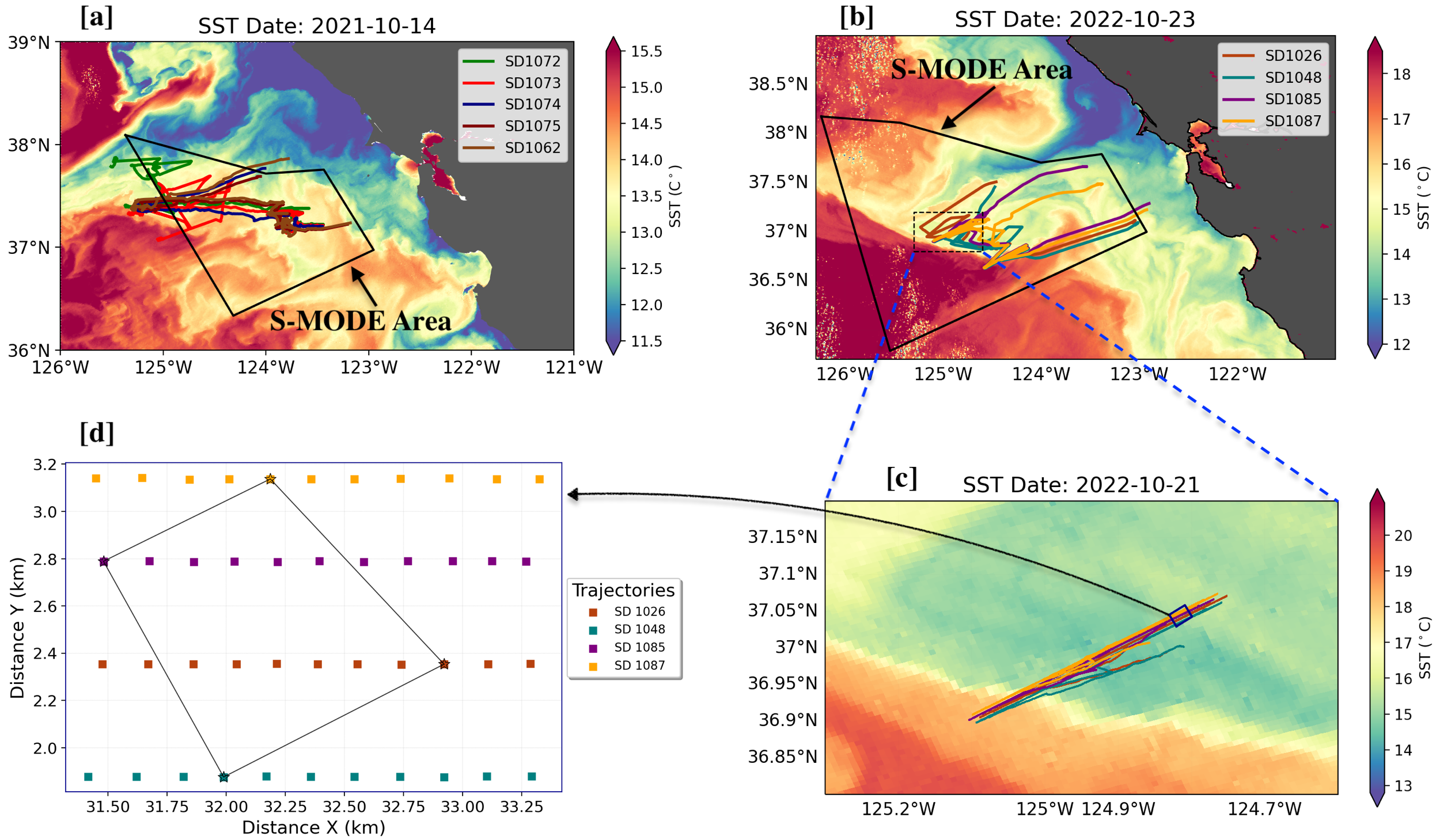 Acoustic Doppler Current Profiler Measurements from Saildrones, with Applications to Submesoscale StudiesPaban Bhuyan, Cesar Rocha, Leonel Romero, and 1 more authorJournal of Atmospheric and Oceanic Technology, 2026
Characterizing submesoscale ocean processes requires high-resolution observations in both space O(1 km) and time O(1 hr). Resolving their velocity gradients requires velocity accuracies of O(1 cm/s). In the present analysis, we utilize multiple mobile platforms, including Saildrones (SDs), to achieve high-resolution measurements of submesoscale features. We assess Saildrone Acoustic Doppler Current Profiler (ADCP) measurements against shipboard ADCP data, both collected during the Sub-Mesoscale Ocean Dynamics Experiment (S-MODE). The results show that the standard 5-minute average Saildrone ADCP along-track velocity difference variability (3 cm/s) is consistent with shipboard ADCP, considered in the present study as a reference. However, direct ADCP comparisons between a Saildrone and the R/V \textitOceanus give small mean difference (\sim1 cm/s). The mean difference could stem from spatial inhomogeneities rather than surface waves, whose influence is expected to be negligible at most sampled depths. Based on 1 Hz Saildrone ADCP data, we found that averaging over 3 minutes of ADCP-derived currents (250 m in space) provides minimal unwanted signal. We investigate the uncertainty of submesoscale current gradients derived from Saildrone ADCP measurements and find that the velocity gradient at a 2 km scale can be obtained with a 0.1f uncertainty using four Saildrones. The methodologies we developed to ascertain optimal averaging window are versatile and applicable to other uncrewed surface vehicles (USV) or multiple-ship arrays.
@article{AcousticDopplerCurrentProfilerMeasurementsfromSaildroneswithApplicationstoSubmesoscaleStudies,
  title = {Acoustic Doppler Current Profiler Measurements from Saildrones, with Applications to Submesoscale Studies},
  author = {Bhuyan, Paban and Rocha, Cesar and Romero, Leonel and Farrar, J Thomas},
  journal = {Journal of Atmospheric and Oceanic Technology},
  pages = {199 - 212},
  year = {2026},
  doi = {10.1175/JTECH-D-24-0114.1},
  publisher = {American Meteorological Society},
  address = {Boston MA, USA},
  volume = {43},
  number = {2},
  url = {https://journals.ametsoc.org/view/journals/atot/43/2/JTECH-D-24-0114.1.xml}
}
2025
-
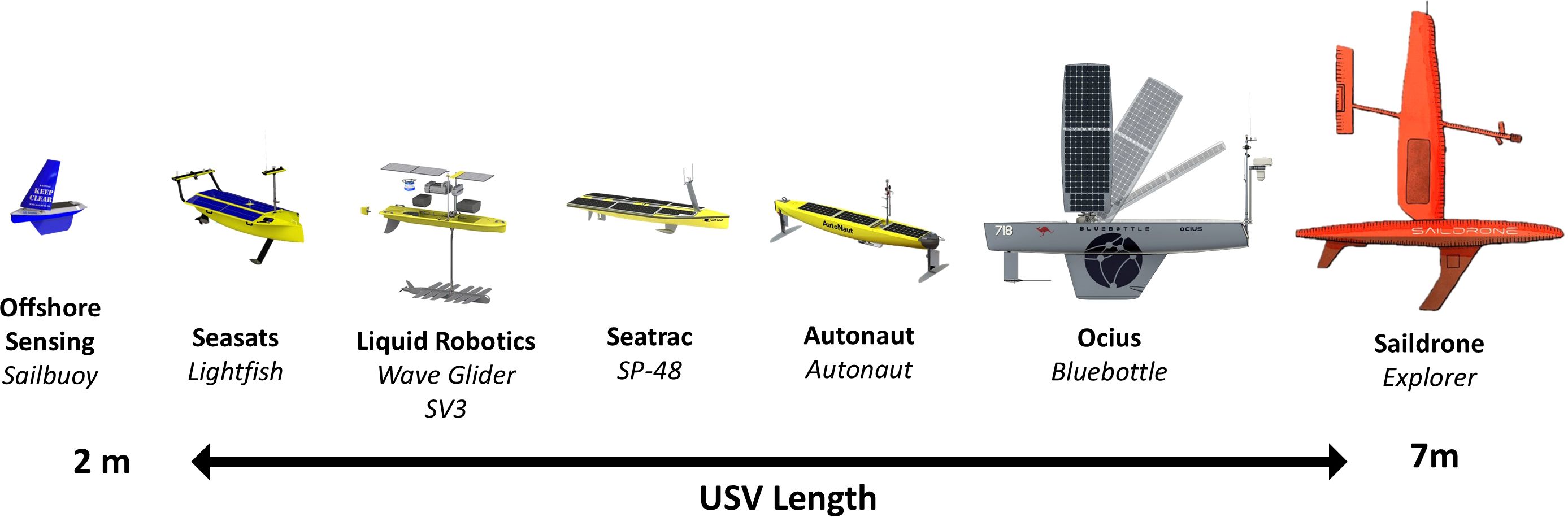 Uncrewed surface vehicles in the Global Ocean Observing System: a new frontier for observing and monitoring at the air-sea interfaceRuth G. Patterson, Meghan F. Cronin, Sebastiaan Swart, and 49 more authorsFrontiers in Marine Science, 2025
Observing air-sea interactions on a global scale is essential for improving Earth system forecasts. Yet these exchanges are challenging to quantify for a range of reasons, including extreme conditions, vast and remote under-sampled locations, requirements for a multitude of co-located variables, and the high variability of fluxes in space and time. Uncrewed Surface Vehicles (USVs) present a novel solution for measuring these crucial air-sea interactions at a global scale. Powered by renewable energy (e.g., wind and waves for propulsion, solar power for electronics), USVs have provided navigable and persistent observing capabilities over the past decade and a half. In our review of 200 USV datasets and 96 studies, we found USVs have observed a total of 33 variables spanning physical, biogeochemical, biological and ecological processes at the air-sea transition zone. We present a map showing the global proliferation of USV adoption for scientific ocean observing. This review, carried out under the auspices of the ‘Observing Air-Sea Interactions Strategy’ (OASIS), makes the case for a permanent USV network to complement the mature and emerging networks within the Global Ocean Observing System (GOOS). The Observations Coordination Group (OCG) overseeing GOOS has identified ten attributes of an in-situ global network. Here, we discuss and evaluate the maturation of the USV network towards meeting these attributes. Our article forms the basis of a roadmap to formalise and guide the global USV community towards a novel and integrated ocean observing frontier.
@article{patterson12uncrewed, author = {Patterson, Ruth G. and Cronin, Meghan F. and Swart, Sebastiaan and Beja, Joana and Edholm, Johan M. and McKenna, Jason and Palter, Jaime B. and Parker, Alex and Addey, Charles I. and Boone, Wieter and Bhuyan, Paban and Buck, Justin J. H. and Burger, Eugene F. and Burris, James and Camus, Lionel and de Young, Brad and du Plessis, Marcel and Flanigan, Mike and Foltz, Gregory R. and Gille, Sarah T. and Grare, Laurent and Hansen, Jeff E. and Hole, Lars Robert and Honda, Makio C. and Hormann, Verena and Kohlman, Catherine and Kosaka, Naoko and Kuhn, Carey and Lenain, Luc and Looney, Lev and Marouchos, Andreas and McGeorge, Elizabeth K. and McMahon, Clive R. and Mitarai, Satoshi and Mordy, Calvin and Nagano, Akira and Nicholson, Sarah-Anne and Nickford, Sarah and O’Brien, Kevin M. and Peddie, David and Ponsoni, Leandro and Ramasco, Virginie and Rozenauers, Nick and Siddle, Elizabeth and Stienbarger, Cheyenne and Sutton, Adrienne J. and Tada, Noriko and Thomson, Jim and Ueki, Iwao and Yu, Lisan and Zhang, Chidong and Zhang, Dongxiao}, title = {Uncrewed surface vehicles in the Global Ocean Observing System: a new frontier for observing and monitoring at the air-sea interface}, journal = {Frontiers in Marine Science}, volume = {12}, year = {2025}, url = {https://www.frontiersin.org/journals/marine-science/articles/10.3389/fmars.2025.1523585}, doi = {10.3389/fmars.2025.1523585}, issn = {2296-7745} } -
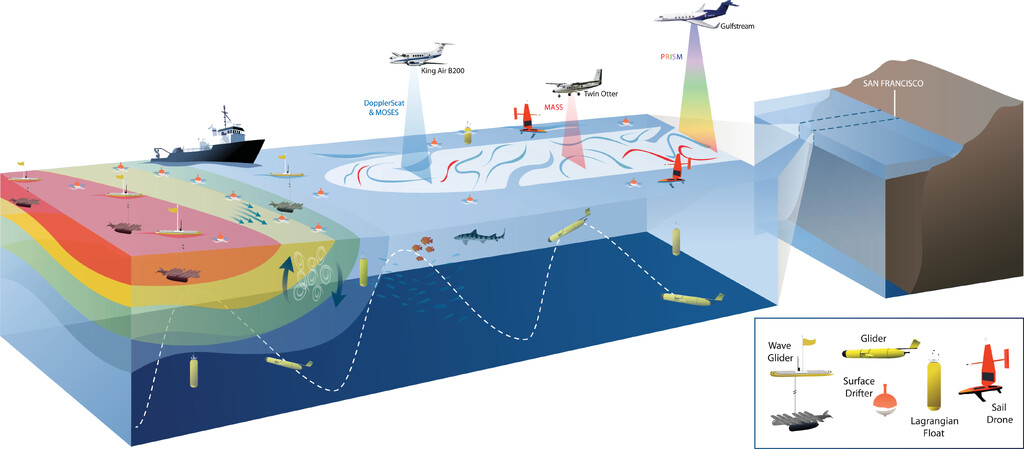 S-MODE: the Sub-Mesoscale Ocean Dynamics ExperimentJ.T. Farrar, E. D’Asaro, E. Rodríguez, and 36 more authorsBulletin of the American Meteorological Society, 2025
The Sub-Mesoscale Ocean Dynamics Experiment (S-MODE) is a NASA Earth Ventures Suborbital investigation designed to test the hypothesis that oceanic frontogenesis and the kilometer-scale (“submesoscale”) instabilities that accompany it make important contributions to vertical exchange of climate and biological variables in the upper ocean. These processes have been difficult to resolve in observations, making model validation challenging. A necessary step toward testing the hypothesis was to make accurate measurements of upper-ocean velocity fields over a broad range of scales and to relate them to the observed variability of vertical transport and surface forcing. A further goal was to examine the relationship between surface velocity, temperature, and chlorophyll measured by remote sensing and their depth-dependent distributions, within and beneath the surface boundary layer. To achieve these goals, we used aircraft-based remote sensing, satellite remote sensing, ships, drifter deployments, and a fleet of autonomous vehicles. The observational component of S-MODE consisted of three campaigns, all conducted in the Pacific Ocean approximately 100-km west of San Francisco during 2021–23 fall and spring. S-MODE was enabled by recent developments in remote sensing technology that allowed operational airborne observation of ocean surface velocity fields and by advances in autonomous instrumentation that allowed coordinated sampling with dozens of uncrewed vehicles at sea. The coordinated use of remote sensing measurements from three aircraft with arrays of remotely operated vehicles and other in situ measurements is a major novelty of S-MODE. All S-MODE data are freely available, and their use is encouraged.
@article{farrar2025s,
  author = {Farrar, J.T. and D'Asaro, E. and Rodríguez, E. and Shcherbina, A. and Lenain, L. and Omand, M. and Wineteer, A. and Bhuyan, P. and Bingham, F. and Villas Boas, A. B. and Czech, E. and D'Addezio, J. and Freilich, M. and Grare, L. and Hypolite, D. and Jacobs, G. and Klein, P. and Lang, S. and Leyba, I. M. and Li, Z. and Mahadevan, A. and McWilliams, J. and Menemenlis, D. and Middleton, L. and Molemaker, J. and O'Neill, L. and Perkovic-Martin, D. and Pizzo, N. and Rainville, L. and Rocha, C. and Samelson, R. M. and Simoes-Sousa, I. and Statom, N. and Thompson, A. and Thompson, D. and Torres, H. and Uchoa, I. and Wenegrat, J. and Westbrook, E.},
  journal = {Bulletin of the American Meteorological Society},
  title = {{S-MODE}: the {S}ub-{M}esoscale {O}cean {D}ynamics {E}xperiment},
  number = {106},
  pages = {E657–E677},
  year = {2025},
  doi = {10.1175/BAMS-D-23-0178.1}
}